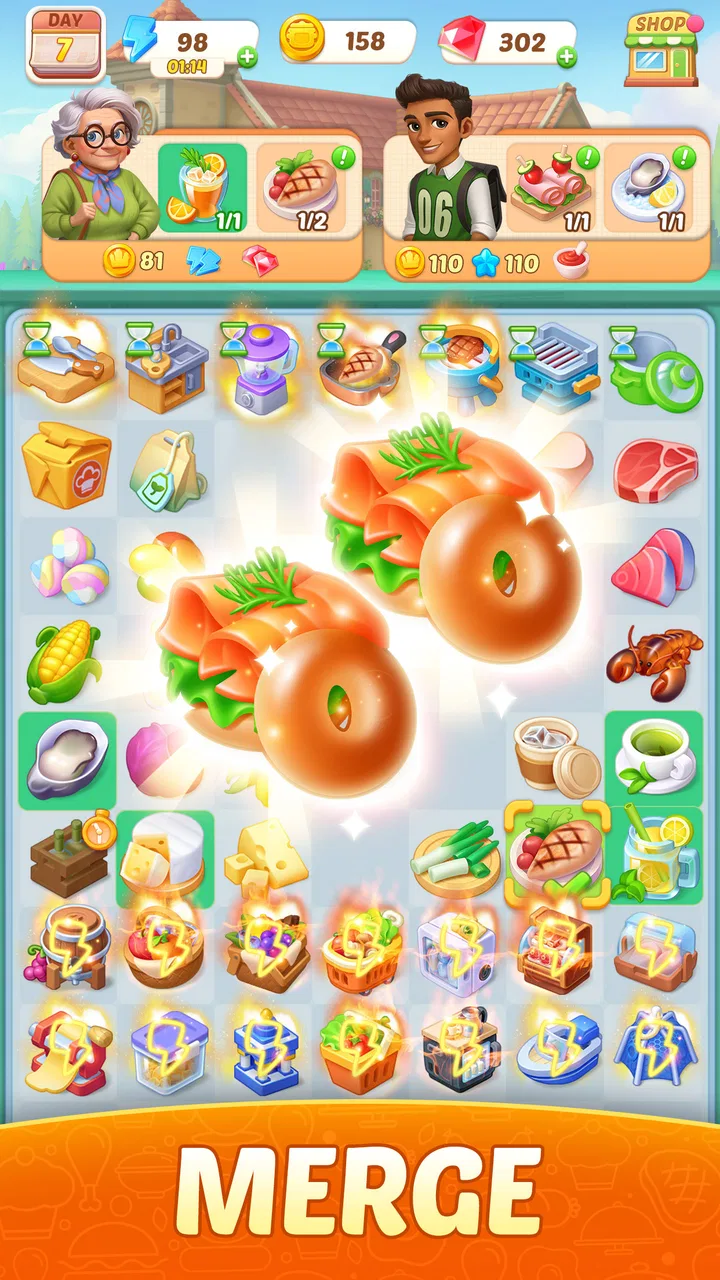
Flambé®: Merge & Cook
- 4.4
- Rating
- 5.00M
- Installs
- Free
- Price

 Analysis by App-foxy
I spent time with Flambé: Merge & Cook as a casual puzzle game, and its main appeal became clear quickly: it turns combining ingredients into a steady cooking routine. You merge items, open new recipes, and gradually work toward a larger culinary operation. That sounds simple, but the interesting part is how the game makes small decisions feel useful. Every ingredient has a place, every empty space matters, and a short session can still leave you with a clear next step.
This is a free game from Microfun Limited, aimed at Everyone, and it sits comfortably in the puzzle category rather than trying to be a demanding restaurant simulator. It has reached over a million installs and holds a 4.5 average from around twenty-seven thousand ratings, which matches my impression that it is designed for broad, relaxed play. I would recommend it most to people who enjoy merge puzzles with a light cooking theme, especially when they want something they can pick up without learning complicated controls.
How Flambé feels in everyday play
I find Flambé easiest to enjoy when I treat each visit as a small puzzle, not a race to finish the whole kitchen. This section looks at how a first session can feel approachable while still rewarding a little thought, then turns to the practical choices that help keep the board manageable.
You May Also Like

 Blood Strike: 2.5 Anniversary
Blood Strike’s Loadouts Turn Every Drop Into a Tactical Gamble
A close look at Blood Strike’s custom loadouts: how fast access to signature weapons reshapes its battle royale rhythm, rewards preparation, and narrows the gap between fights.

 Pandora - Music & Podcasts
Pandora’s Music Is Easy to Start, but Harder to Recover
Pandora’s strength is its low-effort path from a seed to a station. Its weak spot is how much confidence it asks you to place in connection, setup, and quiet recovery.

 8 Ball Pool
 Is Built on Rivalries, Rematches, and Routine
A close look at the rivalries, rematches, shared routines, and unanswered safety questions that turn a quick pool match into a persistent mobile community.

 Samsung Music
’s Quiet Strength Is Playing What You Already Own
Its reach comes less from spectacle than from dependable access to a personal library. That simplicity is both the app’s strongest retention engine and its ceiling.

 AccuWeather: Weather Radar
AccuWeather Review: A Quick, Clear Forecast for Everyday Decisions
For everyday plans, the best forecast is the one you can understand quickly. AccuWeather makes rain timing, radar, and local conditions easy to act on, with a few trade-offs.

 Hill Climb Racing
Why Hill Climb Racing Still Turns Crashes Into One More Run
A tiny car, a bumpy hill and one more upgrade: Hill Climb Racing keeps resurfacing because its simple chaos makes every near-miss feel personal.
More From Our News Desk



A gentle start with a clear loop
The basic rhythm is easy to understand: look at the available ingredients, combine matching pieces, create something more useful, and use the result to unlock recipes or progress through the cooking setup. I like that the central action is visual and direct. You are not wrestling with menus or a long control scheme; the puzzle board is where most of your attention goes.
That simplicity also makes the game approachable for someone who does not normally play puzzle titles. A friend could open it, understand the merge idea within minutes, and begin making progress without needing a tutorial session from another player. The cooking theme gives the combinations a little more personality than abstract colored tiles, even though the moment-to-moment thinking is still about space, timing, and priorities.
In my experience, the game works best when I treat each session as a small planning exercise rather than a race. It is tempting to merge the first available pair immediately, but that can leave awkward gaps or consume an ingredient that would have been more useful as part of a later recipe. The strongest habit is to pause for a few seconds, scan the board, and decide which combination will open the most room.
Speed expectations: quick actions, slower progression
The individual moves feel naturally suited to short play. A merge takes very little time, and there is no need to commit to a long round before putting the phone down. That makes Flambé a good fit for a commute, a break between tasks, or a few minutes while waiting for an appointment. The game does not ask for the same uninterrupted concentration as a traditional match-three level with a strict timer.
However, quick interaction should not be confused with fast overall progression. The satisfying part is often gradual: collecting enough ingredients, arranging the board well, and working through a recipe goal rather than finishing everything in one sitting. Players looking for constant bursts of new content may find the pace restrained. I see that as part of the design, but it is an important expectation to set before downloading.
There is also a useful trade-off here. A slower progression gives casual players room to return without feeling lost, while people who want to optimize every move may start noticing the limits of the loop. If your favorite puzzle games are built around rapid reaction, difficult stages, or leaderboard pressure, this cooking-focused merge format may feel too calm. If you prefer steady progress that can be paused at any moment, the tempo is more comfortable.
What happens during heavier play
The most demanding moments are not necessarily individual merges. They come when the board becomes crowded and several ingredients compete for the same limited spaces. At that point, the game asks for more attention because one careless combination can make the next few moves less convenient. I found that the mental load rises gradually rather than arriving as a sudden difficulty spike.
Longer sessions also make the resource rhythm more noticeable. When I kept playing after completing an obvious recipe objective, I had to think more carefully about whether a merge was genuinely useful or merely satisfying. This is where the game rewards restraint. Saving a lower-level ingredient for a better chain can be more valuable than clearing the board immediately.
A practical routine helped me during crowded moments. I first identify the recipe or upgrade that seems closest, then reserve the spaces needed for its ingredients. After that, I merge only items that either support that target or create enough room to prevent the board from locking up. This is a small change, but it makes the game feel less random and reduces the frustration of having to undo a poor sequence through slow rebuilding.
Another useful approach is to divide a longer session into short goals. Instead of trying to “finish the kitchen,” I might aim to create one needed ingredient, clear a small cluster, or prepare the board for the next recipe. That keeps the game from becoming a repetitive tapping exercise and gives each return to the app a purpose.
Stability and recovering from interrupted play
For a mobile puzzle game, recovery matters almost as much as the puzzle itself. I often play this kind of title in situations where a message, phone call, or change of location can interrupt me. Flambé’s short-action structure is well suited to that pattern because I can stop between decisions rather than needing to protect a carefully timed sequence.
I would still recommend closing a session at a sensible point instead of leaving a complicated board halfway through a move. That is not a criticism unique to this game; it is simply a good habit for any title built around a persistent puzzle space. Before switching away, I prefer to finish the current merge, check that the board looks as expected, and then leave. It makes returning easier because I remember my plan rather than trying to reconstruct it from a half-completed action.
The game’s current version is 1.36.1, so anyone already playing should keep an eye on normal store updates for the best compatibility. I cannot promise identical behavior on every phone, because Android devices vary widely in age and hardware, but the game’s straightforward puzzle presentation does not suggest the same performance burden as a visually intense action game. That is an advantage for casual players who want something less demanding than a 3D title.
Device constraints and practical comfort
Flambé supports Android 5.1 and later, which gives it a broad potential device range. That does not mean every older phone will offer the same experience. A device with limited free storage, an aging battery, or many background apps may still make any game feel less responsive. Before blaming the game, I would close unused apps and make sure the phone has enough room for ordinary updates.
The visual style is part of the device conversation too. The cooking theme needs to make ingredients and recipe progress easy to recognize, but it does not rely on the kind of large animated environments found in high-end games. That should help explain why it is a more sensible choice for an older or modest Android phone than a graphically ambitious restaurant adventure. Even so, people using very old hardware should keep expectations realistic: broad compatibility is not the same as guaranteed smoothness on every model.
Battery use is another reason I would treat it as a moderate-session game. Merge puzzles usually invite repeated checking throughout the day, and that can add up if the app stays open for long stretches. My practical advice is simple: play actively, then leave the game rather than keeping it running in the background. That is especially useful on phones where battery life is already a concern.
Screen size can affect comfort more than raw performance. On a compact phone, a busy board may require more careful tapping, particularly when several ingredients sit close together. I found that slowing down slightly is better than trying to make fast gestures. The game’s relaxed pacing allows that, and deliberate taps reduce the chance of combining the wrong pieces.
The economy changes how the pace feels
Flambé is free to download, but it includes in-app purchases ranging from $0.99 to $99.99 per item. That matters because the natural patience of the merge loop can feel different depending on how you approach optional spending. I think the game is best evaluated as a free, gradual puzzle first. If you enjoy planning and waiting for progress, you can engage with the core loop without treating every delay as a problem.
On the other hand, players who dislike any pressure around purchases should be cautious. The presence of a wide purchase range means the game is not aimed only at people who never spend inside mobile apps. I would not recommend opening it with the expectation that every part of progression will move at the speed of a premium, one-time purchase game.
My advice is to decide your boundary before playing. If you are comfortable spending a small amount occasionally, set a limit and keep the decision separate from frustration. Do not buy simply because the board is crowded or because you want to recover from an inefficient merge. The puzzle is more enjoyable when purchases, if used, support your play style rather than replace planning.
Who will enjoy it most
This is a strong match for players who like organizing spaces, combining objects, and watching a collection develop over time. The culinary theme adds a friendly purpose to the progression, so it is easier to feel that a merge is contributing to a larger kitchen project. It also suits people who prefer games with no complicated controls and who enjoy returning to the same board repeatedly.
A realistic everyday scenario would be playing during a ten-minute lunch break. I might open the game, check which recipe is closest, make a few careful merges, and stop after creating enough room for the next visit. That session feels complete even if I have not unlocked a major milestone. The same structure works for evening relaxation, when I want a low-pressure puzzle rather than an intense challenge.
Families may also appreciate the Everyone rating and accessible presentation, although younger players may still need guidance around optional purchases. The game is easy to understand, but “easy to understand” does not mean every decision is automatically optimal. Showing a child how to save space and avoid impulsive combinations can turn it into a small exercise in planning rather than simple tapping.
I would skip it if you need a fully offline-feeling premium experience with no purchase layer, or if you want a puzzle that tests speed and precision above all else. I would also look elsewhere if your ideal cooking game is about controlling a restaurant in real time, serving customers under pressure, or managing a detailed simulation. Flambé uses cooking as the theme for a merge puzzle; it is not trying to reproduce the full job of running a kitchen.
How it compares with familiar puzzle alternatives
Compared with match-three games, Flambé feels more deliberate. Match-three titles often focus on finding patterns quickly within a fixed level, while this game places more weight on building and arranging a growing set of ingredients. The reward is less about clearing a screen in one dramatic move and more about making a sequence of useful combinations.
Compared with other merge games, the recipe framing gives decisions a clearer identity. You are not only combining objects because the board says so; you are working toward culinary results. That will appeal to players who enjoy a sense of collection and theme. The trade-off is that anyone who has played many merge titles may recognize the underlying rhythm and eventually want more variety than the central loop provides.
Compared with dedicated cooking simulations, it is far less stressful and much easier to play in fragments. You do not need to react to a queue of customers or memorize a complicated control layout. In return, you lose the immediacy of preparing dishes under pressure. Choosing between the two depends on whether you want a calm planning game or a fast service challenge.
Small strategies that make a real difference
The first strategy I would teach a new player is to protect open space. An empty tile is not wasted potential; it is room for the next useful ingredient. Merging everything as soon as possible can make the board look tidy for a moment, but it may remove the flexibility needed to complete a recipe chain.
The second is to work backward from the nearest meaningful goal. If a recipe needs a particular higher-level result, identify the lower-level ingredients that feed into it and avoid spending those pieces on unrelated merges. This prevents the common mistake of making progress that looks impressive but does not help the current objective.
The third is to use short planning pauses after every major board change. A successful merge can alter several future options, so immediately repeating the same gesture is not always efficient. I get better results by checking the new arrangement, spotting newly available pairs, and deciding whether clearing space or building a target ingredient comes first.
A fourth tip is to stop before frustration changes your judgment. When the board becomes crowded, impatient play tends to produce exactly the kind of poor merge that created the problem. Closing the game and returning later is often better than trying to force progress. Because the sessions are naturally compact, taking a break does not feel like abandoning a long campaign.
Overall performance verdict
From a performance perspective, Flambé is best understood as a light, steady puzzle experience rather than a demanding mobile production. Its merge actions are quick to grasp, its board-based play suits short sessions, and its cooking theme gives the progression a reason to continue. The main pressure comes from crowded planning and the gradual pace, not from reflex-heavy gameplay.
Its broad Android compatibility is encouraging for people with older devices, while the current version shows that the game is still presented as an actively maintained mobile title. I would nevertheless keep ordinary device limits in mind: older phones may behave differently, and long sessions can be less comfortable than brief visits. Closing background apps, keeping some storage free, and using deliberate taps are sensible ways to get the most reliable experience.
The best reason to try it is the balance between accessibility and small strategic choices. It is simple enough for a first session, but careful board management gives experienced puzzle players something to think about. The biggest limitation is that the same loop may feel repetitive if you need constant novelty or high-intensity challenge.
Overall, I see Flambé: Merge & Cook as a good free choice for relaxed puzzle fans who enjoy ingredients, recipes, and gradual progress. I would recommend it to a friend who wants a game for short breaks and does not mind a measured pace or optional purchases. I would not recommend it to someone seeking a premium cooking simulation or a fast, competitive puzzle. For the right player, though, the combination of tidy planning, recipe goals, and easy-to-resume sessions makes it a pleasant little kitchen routine.
FAQs for Flambé®: Merge & Cook
01What is Flambé: Merge & Cook?
Flambé: Merge & Cook is an engaging mobile game that combines elements of cooking and merging mechanics. Players are tasked with merging ingredients to create new dishes and unlock recipes. This game is perfect for those who enjoy strategic thinking and culinary creativity, offering a unique twist on traditional cooking games.
02How do the merging mechanics work in Flambé: Merge & Cook?
In Flambé: Merge & Cook, merging mechanics involve combining identical ingredients to form new ones. As you progress, the game introduces more complex recipes, requiring strategic planning and quick decision-making to efficiently use your resources and advance through levels.
03Is Flambé: Merge & Cook a free-to-play game?
Yes, Flambé: Merge & Cook is free-to-play with optional in-app purchases. While you can enjoy most features without spending money, in-app purchases can enhance gameplay by providing additional resources or unlocking premium content. It’s a great option for players who prefer flexibility in their gaming experience.
04What are the system requirements for Flambé: Merge & Cook?
Flambé: Merge & Cook is available for both Android and iOS devices. It requires Android version 5.0 and up, or iOS 10.0 or later. The game is optimized for smooth performance across a wide range of devices, ensuring an enjoyable experience whether on a smartphone or tablet.
05Are there any social features in Flambé: Merge & Cook?
Yes, Flambé: Merge & Cook includes social features that allow you to connect with friends. You can share your progress, compete on leaderboards, and even exchange gifts. These features enhance the interactive aspect of the game, making it more enjoyable to play with others.
Pros
- Engaging and colorful graphics.
- Intuitive controls and interface.
- Frequent updates with new content.
- Variety of recipes to unlock.
- No intrusive ads during gameplay.
Cons
- In-app purchases can be pricey.
- Limited offline capabilities.
- Occasional loading delays.
- Repetitive tasks can be tedious.
- Some levels are quite challenging.

Flambé®: Merge & Cook
Gallery